Our dentists would be happy to give you a full evaluation to see if this treatment is suitable for you.
We’ll be able to answer all your questions, and can work out a treatment plan showing how long the procedure is anticipated to take, as well as the overall price of dental implants. Midtown Dentistry has 5 locations in the greater Houston area.
If you are missing one or more tooth then you may well have considered dental implants. For anyone who is suitable, having a dental implant is by far the best long-term way of replacing lost teeth.
The price of dental implants are very cost-efficient. If properly cared for, your dental implant can last for many years.
The titanium post helps to retain bone density in the jaw by providing the necessary stimulation to the bone, making it one of the healthiest ways of replacing a missing tooth. All other remaining teeth are kept whole and intact, as there is no need to grind down any healthy teeth for a bridge.
How Versatile are Dental Implants?
Dental implants can be used for a number a procedures. They can replace a single crown or replace many teeth. Dental implants can support bridges or even dentures, keeping them firmly in place so you can get on with your life with confidence.
How Complicated a Procedure is Dental Implants?
The actual implant process is quite straightforward and most people find it easy to cope with. If you are nervous then our office can offer you extra sedation to make sure you are comfortable throughout the surgery., pulvinar dapibus leo.
Are There Many Dental Implant Options?
There are various different implants available, and the choice will depend on your individual needs and will be chosen to ensure the success and longevity of your implant. Although it may be possible to place the implants and restorations within a few days, some case may require a longer healing period.
What Type of Houston Dentist Does Dental Implants?
As in most types of surgery, the experience of the dentist doing the dental implants makes a big difference. Specialists like Oral surgeons, Periodontists, and Prosthodontists generally have the most experience, but a general dentist with advanced training is doing the procedure now. Look for the number and successful outcomes the dentist has – this will help give you a good indicator..
Our Dental Implant Patients Love Us
Houston's Midtown Dentistry with over 2,450+ Successful Implants
The dental assistant, Emily and hygienist, Loan are super nice and gentle. Love them! And wow. Dr Penchas implanted a dental implant for me years ago and it popped out today bc something is wrong with it, so he is sending it back to the lab for them to fix w/ no charge to me. Talk about A+ customer service.
read moreread less
Dana
×
Dana
The dental assistant, Emily and hygienist, Loan are super nice and gentle. Love them! And wow. Dr Penchas implanted a dental implant for me years ago and it popped out today bc something is wrong with it, so he is sending it back to the lab for them to fix w/ no charge to me. Talk about A+ customer service.
Just had work done on implants. Dr. P. thank you so much. Excellent job. You and your assistant did an excellent job. Thank you so much. Charles
read moreread less
Charles
×
Charles
Just had work done on implants. Dr. P. thank you so much. Excellent job. You and your assistant did an excellent job. Thank you so much. Charles
My treatment plan was quite an experience. From the drilling and filling to the lifting, grafting, implanting and capping and crowning. All went well. Dr. Gomez, his assistant and his DH all do excellent work. The ladies at the front desk are beautiful and delightfully friendly and helpful.
read moreread less
Steve
×
Steve
My treatment plan was quite an experience. From the drilling and filling to the lifting, grafting, implanting and capping and crowning. All went well. Dr. Gomez, his assistant and his DH all do excellent work. The ladies at the front desk are beautiful and delightfully friendly and helpful.
Our family has been using Midtown Dentistry for over 20 years. Doctors, hygienists and technicians are the best in the class in dental care
Dr. Penchas is a very skillful and brilliant dentist., there is no task too small or too big for him, from implants to filling, every operation is done in the best possible way. Loan is a very thorough , warm and caring hygienist. Ray is professional, kind, and cares about the patient. Everyone will do his/her best to accommodate your needs while at Midtown.
I would highly recommend Midtown dentistry for your dental and oral care.
read moreread less
Ann
×
Ann
Our family has been using Midtown Dentistry for over 20 years. Doctors, hygienists and technicians are the best in the class in dental care
Dr. Penchas is a very skillful and brilliant dentist., there is no task too small or too big for him, from implants to filling, every operation is done in the best possible way. Loan is a very thorough , warm and caring hygienist. Ray is professional, kind, and cares about the patient. Everyone will do his/her best to accommodate your needs while at Midtown.
I would highly recommend Midtown dentistry for your dental and oral care.
I am sort of an amateur expert in dentistry. I have a mouth full of root canals, re-do root canals, implants, and crowns. All done in different cities and different dentists. So, when I say I love Midtown Dentistry (Dr. Melmann) I do know what I'm talking about. I have never had anything even approaching "pain." Dr Melmann is super careful. They charge me less than most dentists charge. Their work is excellent. It's pain free. And the staff is very cool. I could not be happier. Tj
read moreread less
Tech
×
Tech
I am sort of an amateur expert in dentistry. I have a mouth full of root canals, re-do root canals, implants, and crowns. All done in different cities and different dentists. So, when I say I love Midtown Dentistry (Dr. Melmann) I do know what I'm talking about. I have never had anything even approaching "pain." Dr Melmann is super careful. They charge me less than most dentists charge. Their work is excellent. It's pain free. And the staff is very cool. I could not be happier. Tj
The service here is amazing. The second you walk through the door, you're greeted by Juan, who is always so happy to see you. Every time I see him, I just want to give him a big hug because I want to steal some of his energy. Then, you get to meet Sergio, who has an AMAZING memory and makes you feel like you've been friends for years. He makes you feel comfortable, explains what he's doing, explains what the problem and what the fix is, and does his best to distract you from any pain you may experience. I wish I had a Sergio for every uncomfortable/painful experience in my life. There's also Dr. Max and Dr. Milman who have been super helpful with my tooth issues. I felt like I had a pretty complex issue, but they made the whole process seem simple and easy. The staff here have excellent bedside manner, great attitude and knowledge, and more importantly, they seem to have a pretty conservative attitude with how to handle your teeth. They don't try to sell you on "replacing fillings" or getting dental implants. They want to fix what's there and don't want you to spend more money than you need to. Highly recommend.
read moreread less
Jennifer
×
Jennifer
The service here is amazing. The second you walk through the door, you're greeted by Juan, who is always so happy to see you. Every time I see him, I just want to give him a big hug because I want to steal some of his energy. Then, you get to meet Sergio, who has an AMAZING memory and makes you feel like you've been friends for years. He makes you feel comfortable, explains what he's doing, explains what the problem and what the fix is, and does his best to distract you from any pain you may experience. I wish I had a Sergio for every uncomfortable/painful experience in my life. There's also Dr. Max and Dr. Milman who have been super helpful with my tooth issues. I felt like I had a pretty complex issue, but they made the whole process seem simple and easy. The staff here have excellent bedside manner, great attitude and knowledge, and more importantly, they seem to have a pretty conservative attitude with how to handle your teeth. They don't try to sell you on "replacing fillings" or getting dental implants. They want to fix what's there and don't want you to spend more money than you need to. Highly recommend.
Absolutely love Midtown Dentistry. I had major implant work completed at this practice 10 years ago and still no problems.
read moreread less
Judson
×
Judson
Absolutely love Midtown Dentistry. I had major implant work completed at this practice 10 years ago and still no problems.
Definitely recommend this office! Very professional, polite and they work hard to build a relationship with you. Anna has done a great job with all of my cleanings, always making sure I’m okay throughout and gives me great tips on what I can do better! Overall great service!!!
Also, Dr. Penchas has done amazing work with my dental implant. Throughout the whole experience he’s made sure I understand each process and has made it pain free and worry free! Definitely recommend him for all of your dental needs!
read moreread less
Amanda
×
Amanda
Definitely recommend this office! Very professional, polite and they work hard to build a relationship with you. Anna has done a great job with all of my cleanings, always making sure I’m okay throughout and gives me great tips on what I can do better! Overall great service!!!
Also, Dr. Penchas has done amazing work with my dental implant. Throughout the whole experience he’s made sure I understand each process and has made it pain free and worry free! Definitely recommend him for all of your dental needs!
Dr. Penchas is simply the best dentist in Houston! I've been a patient here for almost 20 years and I have always been happy with the crowns and implants that he has done for me.
read moreread less
Susan
×
Susan
Dr. Penchas is simply the best dentist in Houston! I've been a patient here for almost 20 years and I have always been happy with the crowns and implants that he has done for me.
Always an wonderful experience - at the dentist’s office! Morgan is an excellent hygienist, able to do a thorough cleaning without causing any pain to my sensitive teeth. Dr. Tran answered my cosmetic questions with some simple and inexpensive options instead of trying to upsell me on implants or some such. I will never forget how Dr. Penchas helped my husband, who wasn’t even his patient at the time, through a painful weekend when his previous dentist wasn’t returning his calls. These are good people.
read moreread less
Margaret
×
Margaret
Always an wonderful experience - at the dentist’s office! Morgan is an excellent hygienist, able to do a thorough cleaning without causing any pain to my sensitive teeth. Dr. Tran answered my cosmetic questions with some simple and inexpensive options instead of trying to upsell me on implants or some such. I will never forget how Dr. Penchas helped my husband, who wasn’t even his patient at the time, through a painful weekend when his previous dentist wasn’t returning his calls. These are good people.
I don't even have the words to express how much I love this dental practice, the best I have ever visited in my life. I had seen them for an introduction and routine cleaning in June, and was very happy. But three weeks ago, I lost my husband and noticed a tooth was hurting. I had no time to "bother" with the tooth--until it became a true, agonizing emergency. I called and said I had an emergency. I also explained that I am pain and dental phobic. They took me within two hours of my call, soothed my fears, and treated me like an esteemed guest instead of a patient.
I was assigned to Dr. Shalev, a skilled and wonderful woman who is my heroine forever. She did not rush, she explained everything to me, she questioned me closely about my phobia. I knew I was not on her normal schedule, being an emergency, but she acted like I was her only patient of the day. She removed the badly infected tooth PAINLESSLY. I did not think that was possible. She explained what she was doing every step of the way, even why the tooth could not be saved, and options for afterwards (implants, etc.)
I almost skipped out of the office, pain free, feeling great, and in love with my dentist. I see her again in a week for post-op. This is day two. I have no pain, I have had almost no side effects. If I, a dental phobe, can give this good a review, believe me--this is a great dentist.
read moreread less
Wendy
×
Wendy
I don't even have the words to express how much I love this dental practice, the best I have ever visited in my life. I had seen them for an introduction and routine cleaning in June, and was very happy. But three weeks ago, I lost my husband and noticed a tooth was hurting. I had no time to "bother" with the tooth--until it became a true, agonizing emergency. I called and said I had an emergency. I also explained that I am pain and dental phobic. They took me within two hours of my call, soothed my fears, and treated me like an esteemed guest instead of a patient.
I was assigned to Dr. Shalev, a skilled and wonderful woman who is my heroine forever. She did not rush, she explained everything to me, she questioned me closely about my phobia. I knew I was not on her normal schedule, being an emergency, but she acted like I was her only patient of the day. She removed the badly infected tooth PAINLESSLY. I did not think that was possible. She explained what she was doing every step of the way, even why the tooth could not be saved, and options for afterwards (implants, etc.)
I almost skipped out of the office, pain free, feeling great, and in love with my dentist. I see her again in a week for post-op. This is day two. I have no pain, I have had almost no side effects. If I, a dental phobe, can give this good a review, believe me--this is a great dentist.
I love Dr Penchas, Loan, and Ray! I have been coming here for 14 years and wouldn't trust my teeth, implants, or bone graft to anyone else.
read moreread less
Melissa
×
Melissa
I love Dr Penchas, Loan, and Ray! I have been coming here for 14 years and wouldn't trust my teeth, implants, or bone graft to anyone else.
I have been coming here since 2002 due to a complicated set of implants messed up in the beginning by someone else. Dr Penchas fixed me up, and Ray and Loan have been taking great care of me ever since. They have been with me through a lot, and I really do feel like they are great friends who care about me and my teeth �
read moreread less
Melissa
×
Melissa
I have been coming here since 2002 due to a complicated set of implants messed up in the beginning by someone else. Dr Penchas fixed me up, and Ray and Loan have been taking great care of me ever since. They have been with me through a lot, and I really do feel like they are great friends who care about me and my teeth �
My father had went to a foreign country to have dental implants done to try to save some money. When he came back, his jaw was infected so bad. After research, we found Dr. Penchas! We drove over an hour for every visit. When we went in the staff was so friendly! He fixed his entire mouth. It was a miracle he could fix his teeth! He's a miracle worker! I'd recommend him to anyone and everyone!
read moreread less
Lisa
×
Lisa
My father had went to a foreign country to have dental implants done to try to save some money. When he came back, his jaw was infected so bad. After research, we found Dr. Penchas! We drove over an hour for every visit. When we went in the staff was so friendly! He fixed his entire mouth. It was a miracle he could fix his teeth! He's a miracle worker! I'd recommend him to anyone and everyone!
An amazing experience with Dr. Penchas And his wonderful staff , who make You feel so comfortable and calming .
Dr. Penchas is an "Artist " , skilled , painless , explaining every step during the process .
I had extensive procedure , with removal of a bridge to implants .,
Dr. Penchas performed his artistry
In motion and performed with skill and finesse .. While making sure you felt comfortable, without experiencing any discomfort .
Dr. Penchas and His staff are the
Best of the Best .. They are family
For Life ..Thank You , Dr. Penchas , for giving me my smile
Back again .
read moreread less
Christine
×
Christine
An amazing experience with Dr. Penchas And his wonderful staff , who make You feel so comfortable and calming .
Dr. Penchas is an "Artist " , skilled , painless , explaining every step during the process .
I had extensive procedure , with removal of a bridge to implants .,
Dr. Penchas performed his artistry
In motion and performed with skill and finesse .. While making sure you felt comfortable, without experiencing any discomfort .
Dr. Penchas and His staff are the
Best of the Best .. They are family
For Life ..Thank You , Dr. Penchas , for giving me my smile
Back again .
Several years ago I went to Dr. Penchas to have implants. It was a wonderful experience. I had a full set of implants on the top. After a short period of time you feel as they are your real teeth, not implants. Never worry about toothaches are cavities. I will be 70 in December. Last week, after 3 years wearing implants, I broke one tooth biting into a frozen piece of candy. I have bitting into frozen candy so many times with no breakage, except this time. I called Dr. Penchas office the 1st thing the next day. They gave me an appointment that day. The young lady wanted to know if I was in pain. I was not but wanted my tooth ASAP to make me look the best, at lease for a 70 year old man. Dr. Penchas removed the top set of implant and put denture in temporary so as I did not scare anyone or look over 90 years old. He had to send my implants to the lab to be repaired. In 3 days they called me to come in that day and have implants put back in. Thank the Lord for Dr. Penchas and Ray. Got implants with very little discomfort. Love every one at this office. All so helpful. Now back to eating everything, except frozen candy. It is great, thanks to Dr, Penchas.
read moreread less
Art
×
Art
Several years ago I went to Dr. Penchas to have implants. It was a wonderful experience. I had a full set of implants on the top. After a short period of time you feel as they are your real teeth, not implants. Never worry about toothaches are cavities. I will be 70 in December. Last week, after 3 years wearing implants, I broke one tooth biting into a frozen piece of candy. I have bitting into frozen candy so many times with no breakage, except this time. I called Dr. Penchas office the 1st thing the next day. They gave me an appointment that day. The young lady wanted to know if I was in pain. I was not but wanted my tooth ASAP to make me look the best, at lease for a 70 year old man. Dr. Penchas removed the top set of implant and put denture in temporary so as I did not scare anyone or look over 90 years old. He had to send my implants to the lab to be repaired. In 3 days they called me to come in that day and have implants put back in. Thank the Lord for Dr. Penchas and Ray. Got implants with very little discomfort. Love every one at this office. All so helpful. Now back to eating everything, except frozen candy. It is great, thanks to Dr, Penchas.
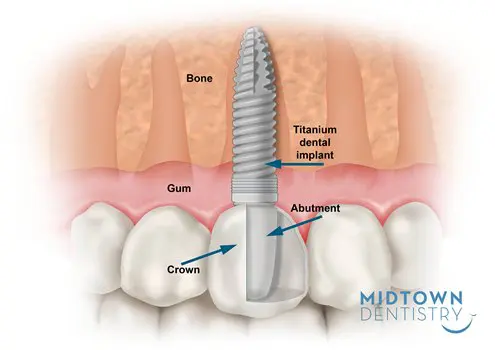
Implant – a screw made of titanium that becomes the new tooth ‘root’. Titanium is not rejected by the body.
The Abutment
Abutment – a small piece that insures a snug fit of the crown and implant – Made of ceramic or titanium.
The Crown
Crown – as a last step a crown or bridge is attached to the top of the implant as the final stage of the process
What is the Cost of a Single Back Tooth Implant?
In the Houston area a single replacement back implant tooth will cost around $3,450. This Includes Everything – The CT-Scan, the sedation, the procedure and all the hardware Implant or screw, the abutment and the crown
What is the Cost of a Single Front Tooth Implant?
In the Houston area a single replacement premium front implant tooth will cost around $3,450-$3,850. This cost should include Everything – The CT-Scan, the sedation, the procedure and all the hardware Implant or screw, the abutment and the crown can get on with your life with confidence.
Does Adding Bone Increase the Cost of a Dental Implant?
Yes, Adding bone increases the cost. In the Houston area a single replacement back implant tooth will cost around $3,250-$4200. This Includes Everything to do with the implant and tooth – The CT-Scan, the sedation, the procedure and all the hardware Implant or screw, the abutment and the crown.
Adding bone adds to the cost, difficulty and time needed to get a new tooth. The added bone can come from another area of the jaw of the person themselves or bought in the form of pre-packaged bone from human or animal donors.
Are Front Teeth More Difficult to Replace?
The teeth in front are often difficult to replace and cost more than teeth in the back of the mouth. In many cases, they will require some bone to be implanted prior to replacement
The price includes the surgery to insert the titanium post and the implant crown.
What’s the average price of dental implants?
The average price for an implant is comparable to replacing a tooth with a bridge.
Dental implants make finanical sense
What are the disadvantage of dentures and bridges?
If you already live with a dental bridge or denture then you’ll know these solutions are far from ideal.
Dentures have a tendency to move around
Dentures need replacing every three to six years.
Dentures make it difficult to eat all the foods you used to enjoy.
Dentures can make it tricky to speak.
The longer you wear dentures the more bone is resorbed making it difficult to fit them effectively
Dental Bridges need to be replaced every 10-years or so